How to Select a Straight Trailer Axle for Load Fit and Braking
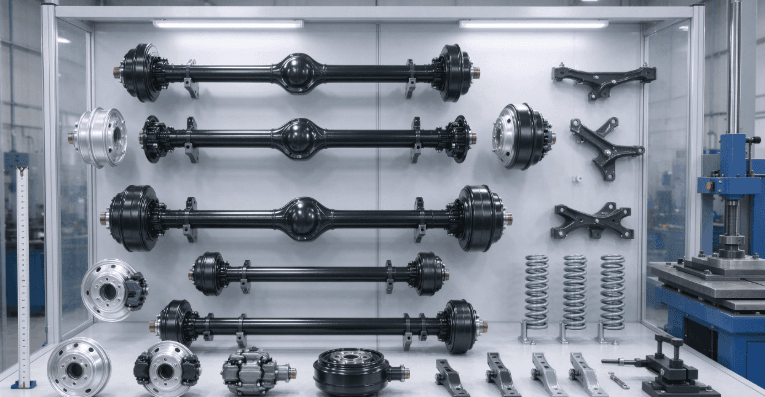
<p><span style="color: rgb(32, 32, 32); font-size: 10.5pt;">A straight trailer axle must fit the trailer’s load plan, suspension geometry, wheels, brakes, and regulatory market. The nominal capacity printed on an axle listing is only one part of that decision; it does not establish a complete trailer’s legal gross rating or confirm that tires, hubs, springs, frame, and brakes are compatible. This guide explains what to verify when sourcing a straight trailer axle, uses Runheng’s published model configurations as examples, and identifies the documents a buyer should request before placing an order.</span></p><h2><span style="color: rgb(0, 0, 0); font-size: 12pt;"><strong>In this guide</strong></span></h2><p><span style="color: rgb(32, 32, 32); font-size: 10.5pt;">Understand ratings; measure the trailer; match hub and brake configurations; use catalog data correctly; review an example selection; prepare an RFQ; frequently asked questions.</span></p><h1><span style="color: rgb(0, 0, 0); font-size: 15pt;"><strong>Begin with the trailer rating, not the catalog headline</strong></span></h1><p><span style="color: rgb(32, 32, 32); font-size: 10.5pt;">First establish the trailer manufacturer’s gross vehicle weight rating and the gross axle weight rating assigned to each axle. NHTSA defines GAWR as the load-carrying capacity of an axle system at the tire-ground interface; the complete system includes components such as wheels, rims, hubs, and tires, rather than the beam alone [1]. This distinction prevents a common mistake: choosing an axle beam label and assuming it determines the finished trailer rating.</span></p><p><span style="color: rgb(32, 32, 32); font-size: 10.5pt;">The axle and running gear should be selected against the design load distribution, including tongue or pin load where relevant, dynamic service, and the number of axles. Do not divide GVWR by axle count and stop there; the actual axle loading depends on hitch load, cargo position, suspension, and vehicle configuration. The trailer manufacturer or qualified engineer must assign ratings and verify the whole system. Regulations differ by market, so the required vehicle labels, brake rules, and component evidence must be checked for the destination.</span></p><h1><span style="color: rgb(0, 0, 0); font-size: 15pt;"><strong>Measure the fit before asking for price</strong></span></h1><p><span style="color: rgb(32, 32, 32); font-size: 10.5pt;">The most useful dimensional inputs are hub-face distance, spring-center distance, axle-beam profile, spindle and bearing arrangement, spring seat or hanger geometry, and ride height. Hub-face distance affects wheel position and track width; spring-center distance must align with the suspension. Confirm whether the drawing dimensions are measured between the outside hub faces, spindle shoulders, or another datum. A small measurement error can create tire clearance problems or force suspension rework.</span></p><p><span style="color: rgb(32, 32, 32); font-size: 10.5pt;">Then match the wheel and hub interface: bolt pattern, stud size, hub pilot if applicable, wheel offset, bearing set, grease or oil configuration, and brake package. A 5-on-4.5 pattern, for example, does not by itself prove wheel compatibility; stud dimensions, hub geometry, load rating, and brake clearance still need checking. Record whether the requested assembly is idler or braked, and if braked, specify the brake type, backing plate, drum or rotor, actuator, and electrical or hydraulic control requirements.</span></p><h1><span style="color: rgb(0, 0, 0); font-size: 15pt;"><strong>Use capacity and bolt pattern as filters</strong></span></h1><p><span style="color: rgb(32, 32, 32); font-size: 10.5pt;">Runheng’s product category lists straight axle configurations spanning 2,000 lb idler assemblies through 12,000 lb brake assemblies, with configurations including 4-on-4, 5-on-4.5, 5-on-4.75, 5-on-5, 5-on-5.5, 6-on-5.5, and 8-on-6.5 bolt patterns [2]. These are supplier-published catalog labels. They are useful for narrowing a request, but buyers should confirm whether a stated rating refers to one axle assembly and what components are included. Never treat a listing as a substitute for the trailer maker’s GAWR/GVWR assignment or for load testing and regulatory approval.</span></p><h2><span style="color: rgb(0, 0, 0); font-size: 12pt;"><strong>Published data and project reference</strong></span></h2><table style="min-width: 100px;"><colgroup><col style="min-width: 25px;"><col style="min-width: 25px;"><col style="min-width: 25px;"><col style="min-width: 25px;"></colgroup><tbody><tr><td colspan="1" rowspan="1"><p><span style="color: rgb(255, 255, 255); font-size: 9pt;"><strong>Example listed configuration</strong></span></p></td><td colspan="1" rowspan="1"><p><span style="color: rgb(255, 255, 255); font-size: 9pt;"><strong>Catalog rating</strong></span></p></td><td colspan="1" rowspan="1"><p><span style="color: rgb(255, 255, 255); font-size: 9pt;"><strong>Interface shown</strong></span></p></td><td colspan="1" rowspan="1"><p><span style="color: rgb(255, 255, 255); font-size: 9pt;"><strong>Confirm before ordering</strong></span></p></td></tr><tr><td colspan="1" rowspan="1"><p><span style="color: rgb(32, 32, 32); font-size: 8.5pt;">2K idler</span></p></td><td colspan="1" rowspan="1"><p><span style="color: rgb(32, 32, 32); font-size: 8.5pt;">2,000 lb</span></p></td><td colspan="1" rowspan="1"><p><span style="color: rgb(32, 32, 32); font-size: 8.5pt;">4-on-4</span></p></td><td colspan="1" rowspan="1"><p><span style="color: rgb(32, 32, 32); font-size: 8.5pt;">Dimensions, spindle, hub, bearings, wheel rating.</span></p></td></tr><tr><td colspan="1" rowspan="1"><p><span style="color: rgb(32, 32, 32); font-size: 8.5pt;">3.5K brake</span></p></td><td colspan="1" rowspan="1"><p><span style="color: rgb(32, 32, 32); font-size: 8.5pt;">3,500 lb</span></p></td><td colspan="1" rowspan="1"><p><span style="color: rgb(32, 32, 32); font-size: 8.5pt;">5-on-4.5 / other listed patterns</span></p></td><td colspan="1" rowspan="1"><p><span style="color: rgb(32, 32, 32); font-size: 8.5pt;">Brake type, drum, backing plate, actuator and wiring.</span></p></td></tr><tr><td colspan="1" rowspan="1"><p><span style="color: rgb(32, 32, 32); font-size: 8.5pt;">6K idler or brake</span></p></td><td colspan="1" rowspan="1"><p><span style="color: rgb(32, 32, 32); font-size: 8.5pt;">6,000 lb</span></p></td><td colspan="1" rowspan="1"><p><span style="color: rgb(32, 32, 32); font-size: 8.5pt;">6-on-5.5</span></p></td><td colspan="1" rowspan="1"><p><span style="color: rgb(32, 32, 32); font-size: 8.5pt;">Confirm brake inclusion and suspension geometry.</span></p></td></tr><tr><td colspan="1" rowspan="1"><p><span style="color: rgb(32, 32, 32); font-size: 8.5pt;">7K brake</span></p></td><td colspan="1" rowspan="1"><p><span style="color: rgb(32, 32, 32); font-size: 8.5pt;">7,000 lb</span></p></td><td colspan="1" rowspan="1"><p><span style="color: rgb(32, 32, 32); font-size: 8.5pt;">8-on-6.5</span></p></td><td colspan="1" rowspan="1"><p><span style="color: rgb(32, 32, 32); font-size: 8.5pt;">Verify hub, bearings, brake package, and wheel capacity.</span></p></td></tr><tr><td colspan="1" rowspan="1"><p><span style="color: rgb(32, 32, 32); font-size: 8.5pt;">10K / 12K brake</span></p></td><td colspan="1" rowspan="1"><p><span style="color: rgb(32, 32, 32); font-size: 8.5pt;">10,000 / 12,000 lb</span></p></td><td colspan="1" rowspan="1"><p><span style="color: rgb(32, 32, 32); font-size: 8.5pt;">8-on-6.5</span></p></td><td colspan="1" rowspan="1"><p><span style="color: rgb(32, 32, 32); font-size: 8.5pt;">Request exact drawing and complete-system rating details.</span></p></td></tr></tbody></table><p><span style="color: rgb(0, 0, 0); font-size: 10.5pt;"> </span></p><h1><span style="color: rgb(0, 0, 0); font-size: 15pt;"><strong>A worked sourcing example</strong></span></h1><p><span style="color: rgb(32, 32, 32); font-size: 10.5pt;">Suppose a buyer is replacing an axle on a single-axle utility trailer and the approved design calls for a 3,500 lb braked axle. Runheng’s catalog includes 3.5K brake configurations and multiple bolt patterns [2]. The buyer should identify the existing or designed hub-face and spring-center measurements, confirm the wheel’s 5-on-4.5 interface if that is the selected version, and verify bearing and spindle compatibility. The brake assembly must match the trailer’s control system, electrical supply, drum dimensions, and regulatory requirements. Then the buyer should compare tire load rating, suspension, frame attachment, and the manufacturer’s assigned GAWR. This is a selection workflow, not an endorsement of a specific model for any vehicle.</span></p><p><span style="color: rgb(32, 32, 32); font-size: 10.5pt;">A NHTSA interpretation concerning a boat trailer illustrates why the full system matters: the agency discussed a condition where actual loading on an axle system exceeded its GAWR at the trailer’s GVWR and treated the issue as safety-relevant [3]. This is a regulatory interpretation, not a product test or a statement about Runheng. It demonstrates that choosing a component by its advertised beam capacity alone can miss the system-level rating question.</span></p><h1><span style="color: rgb(0, 0, 0); font-size: 15pt;"><strong>Prepare a complete RFQ</strong></span></h1><p><span style="color: rgb(32, 32, 32); font-size: 10.5pt;">For an accurate quote, send a dimensioned drawing or a verified measurement sheet, quantity, target load rating, axle count, idler or brake requirement, bolt pattern, spindle/bearing details if known, hub-face, spring-center, suspension type, wheel and tire information, finish or corrosion exposure, destination market, and target delivery date. Identify which components must arrive assembled and which will be installed by the trailer builder. Ask the supplier to mark all measurement datums on its confirmation drawing.</span></p><p><span style="color: rgb(32, 32, 32); font-size: 10.5pt;">Request the bill of materials, dimensional drawing, product data, load-rating basis, inspection documents, packaging method, and any certificates required by the destination market. If a custom configuration is considered, ask which dimensions or components are configurable and what validation is needed. Runheng’s manufacturing page describes production and inspection activities and invites technical review of standard or drawing-led configurations; confirm the scope for the requested model directly with the company [4].</span></p><h1><span style="color: rgb(0, 0, 0); font-size: 15pt;"><strong>Frequently asked questions</strong></span></h1><p><span style="color: rgb(32, 32, 32); font-size: 10.5pt;"><strong>Does the axle rating equal trailer GVWR?</strong> No. GVWR is assigned to the complete trailer. Axle-system ratings, tires, wheels, suspension, frame, brakes, and hitch capacity all affect the approved vehicle rating.</span></p><p><span style="color: rgb(32, 32, 32); font-size: 10.5pt;"><strong>Can I select by bolt pattern alone?</strong> No. Bolt pattern is one interface dimension. Check stud and hub details, wheel offset, bearings, brake clearance, and load capability.</span></p><p><span style="color: rgb(32, 32, 32); font-size: 10.5pt;"><strong>Can a braked axle be used as an idler axle?</strong> They serve different functions. The required braking system depends on the trailer design and destination regulations; confirm the complete brake configuration.</span></p><p><span style="color: rgb(32, 32, 32); font-size: 10.5pt;"><strong>What if the old axle label is missing?</strong> Do not estimate from appearance. Measure the assembly, inspect component markings, consult the trailer maker, and obtain a qualified engineering assessment before assigning a replacement rating.</span></p><h1><span style="color: rgb(0, 0, 0); font-size: 15pt;"><strong>Conclusion and next step</strong></span></h1><p><span style="color: rgb(32, 32, 32); font-size: 10.5pt;">A straight trailer axle purchase should begin with the approved trailer rating and a precise dimensional fit, then match hubs, wheels, suspension, and brakes. Runheng’s catalog offers a range of listed capacity and bolt-pattern configurations, but the buyer must confirm exactly what each model includes and how it fits the full running-gear design. Send a drawing, measurements, load plan, and destination requirements to the supplier and trailer engineer before approving production.</span></p><h1></h1><p></p>